The A locus is in the middle of a transition, and a breeder needs to understand both sides of it. For decades it was described as a simple four-allele series — Ay, aw, at, a — and that description is what appears on nearly every commercial panel and in nearly every breeder conversation.
In 2021, Bannasch and colleagues showed that account was too simple. Not wrong so much as coarse: it groups together dogs that are genuinely different from one another. This article is the bridge between the two.
What the Four-Allele Model Got Wrong
The A locus is not a series of four alternative alleles. It is a modular system of two separate regulatory regions, each with several variants, and the pattern a dog displays is determined by which combination of the two it carries.
The two regions are:
- The ventral promoter (VP), which governs how far up the body phaeomelanin extends.
- The hair cycle promoter (HCP), which governs the banding within each individual hair.
A dog carries one of two ventral variants and one of five hair cycle variants. The pairing of the two — a haplotype — determines the pattern.
That structure is why the old model strained. The legacy allele Ay covers two distinct haplotypes producing visibly different sables. The legacy allele at covers two more: one is the phantom, the other is the creeping tan whose markings expand as the dog matures. To be told those are the same allele behaving inconsistently is to be told something false.
The Bridge Table
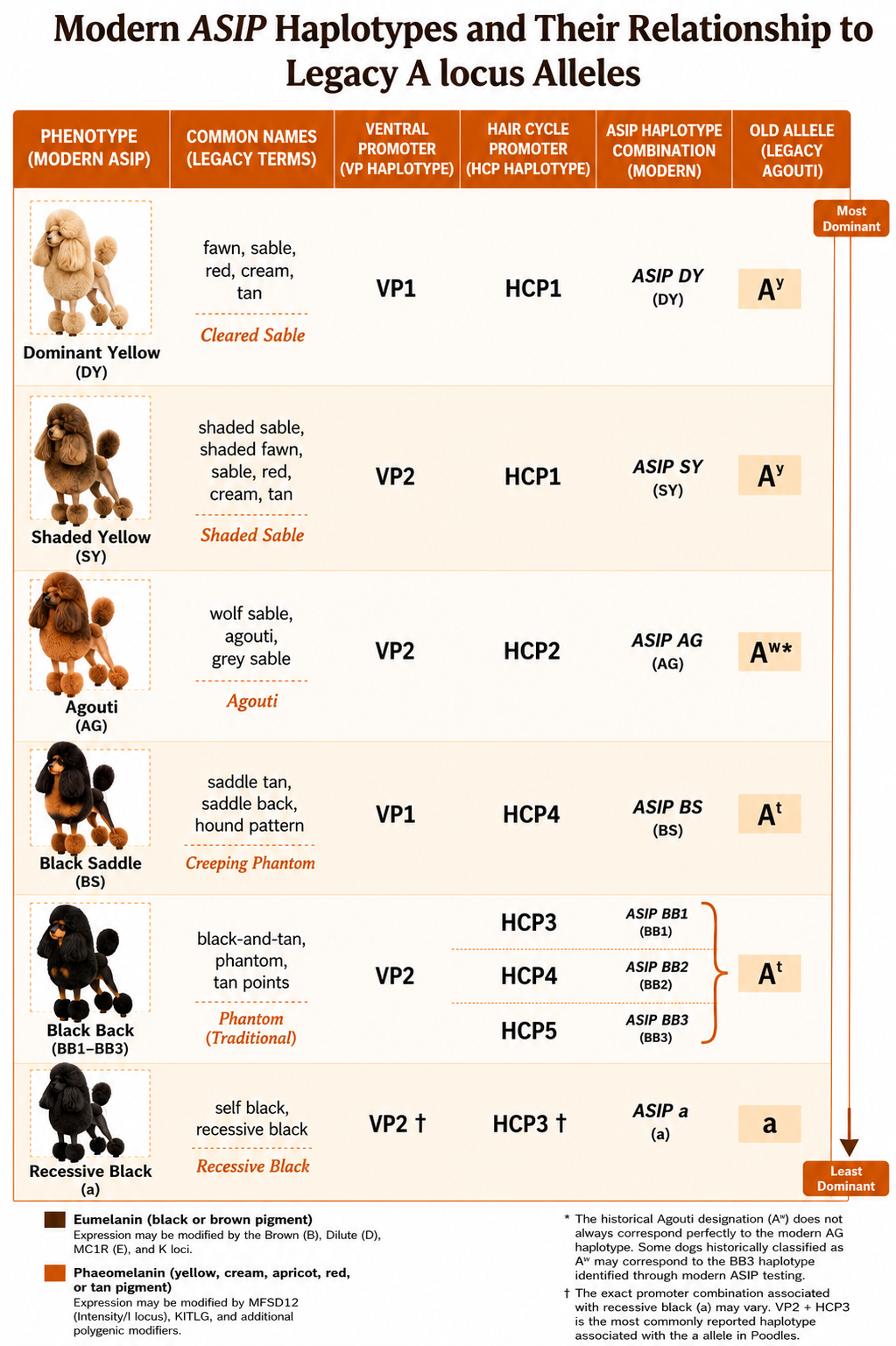
Read it left to right if you have a haplotype report, and right to left if you have a legacy one. The five phenotypes the haplotype system recognises, in order of dominance, are dominant yellow, shaded yellow, agouti, black saddle and black back — with recessive black at the bottom.
The Five, One at a Time
Dominant Yellow (DY) — legacy Ay
VP1 + HCP1. The cleared sable: phaeomelanin across the coat with little or no dark tipping. Called fawn, sable, red, cream or tan depending on who is describing it.
Shaded Yellow (SY) — also legacy Ay
VP2 + HCP1. The shaded sable, which keeps the dark tipping along the back and ears. Note the promoter difference from DY is a single region — one variant at the ventral promoter separates a cleared sable from a shaded one.
This is the distinction the legacy test cannot make. Both dogs read as Ay. If you are breeding sable and want to know whether a dog will clear or hold its shading, the four-allele panel cannot tell you, and no amount of staring at the pedigree will settle it.
Agouti (AG) — legacy aw
VP2 + HCP2. Banded hairs, alternating phaeomelanin and eumelanin along each shaft: wolf sable, grey sable. Uncommon in poodles.
The correspondence here is the loosest of the set, and the book flags it explicitly: some dogs historically recorded as aw turn out on haplotype testing to be black back instead. Treat a legacy aw result as a strong hint rather than a fact.
Black Saddle (BS) — legacy at
VP1 + HCP4. Tan points with the eumelanin receding to a saddle over the back as the dog matures. Called saddle tan, saddle back or hound pattern elsewhere.
In poodles, this is what the community calls creeping tan — and this is the one that causes the most frustration in a phantom programme. A creeping tan puppy is not an incorrectly marked phantom, and it is not a phantom that "went wrong". It is a different haplotype, doing exactly what its haplotype does.
Black Back (BB1–BB3) — also legacy at
VP2 + HCP3, HCP4 or HCP5. The phantom proper: eumelanin over the back, phaeomelanin at the defined points, stable through life. Three subtypes, differing only in the hair cycle promoter.
Recessive Black (a)
A loss-of-function variant. Solid eumelanin when homozygous. Rare in poodles.
Why This Matters at the Whelping Box
The dominance chain is DY > SY > AG > BS > BB > a. Two practical consequences follow, and they are the reason the haplotype system is worth the cost in specific cases:
-
A phantom line throwing dogs whose markings expand with age is not failing. Those dogs are black saddle, not black back. Legacy testing calls both at and leaves you to wonder what went wrong. Nothing went wrong.
-
Sable that clears versus sable that holds is a coin you cannot see. Both are Ay. If that distinction matters to your programme, haplotype-level testing is the only thing that answers it.
And the same caveat as everywhere else on this site: an ee dog shows none of this either. The A locus distributes eumelanin, and an ee dog has none in its coat. The haplotype is still there, still inherited, still perfectly capable of appearing in the next generation.
Which Test Should You Order?
Standard commercial A locus panels report the legacy four alleles and are adequate for most purposes. Haplotype-level ASIP testing, now offered by several laboratories, is worth the cost in two circumstances:
- You are working with sable and want to know whether a dog is dominant yellow or shaded yellow. The legacy test cannot distinguish them.
- You have a phantom line producing dogs whose markings expand with age. That is black saddle rather than black back, and it is not a marking fault.
Outside those two cases, the legacy panel will serve.
A Note on Notation
This site leads with the legacy notation, and the reason is practical rather than
scientific. The report in front of the breeder says at/at. The stud contract
says phantom. The conversation at the show says phantom. Insisting on
VP2-HCP3/VP2-HCP4 would be more precise and less useful, and every sentence
would need translating back into the language breeders actually work in.
But the haplotype system explains things the four-allele model cannot. Where it does, this site says so.
Free Tool
Apply This Knowledge
Model any parent pair with our interactive genetics calculator.